The short answer
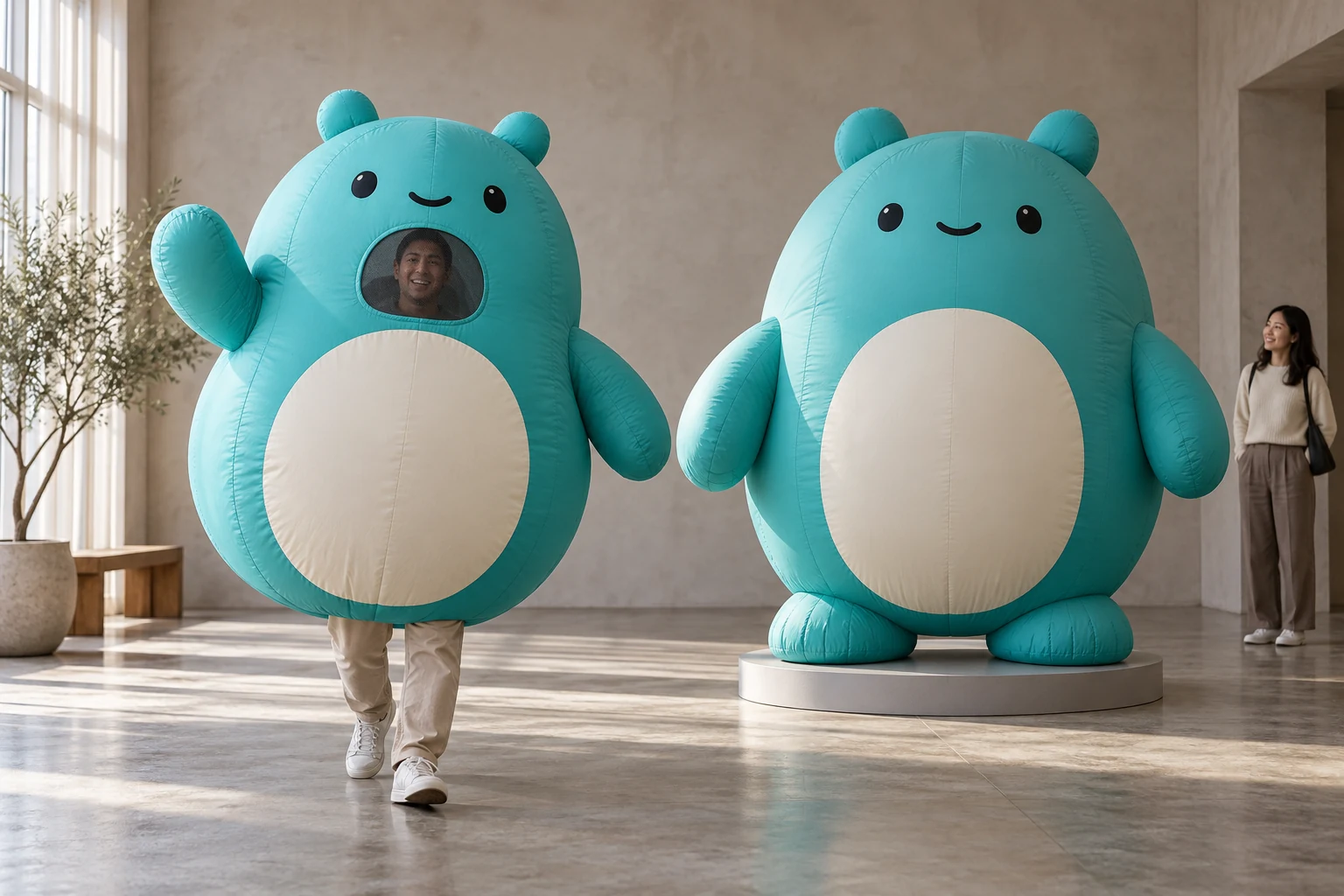
Choose a wearable inflatable mascot when the activation depends on a character responding to people during planned appearances. Choose a static inflatable display when the campaign needs a consistent visual landmark or a fixed photo destination. A combined approach can serve both purposes, provided each format has its own operating plan.
Treat a wearable concept as a project-specific design proposal, not a confirmed operating specification. Feasibility, performer operation and venue requirements should be reviewed before approval.
Start with the audience action
A moving mascot can wave, turn toward a visitor or become part of a hosted reveal. Its value lies in those responsive moments. That makes a wearable direction worth exploring for scheduled meet-and-greets, short launch appearances and hosted activity zones.
A fixed mascot gives visitors a recognizable place to approach. The agency can plan the backdrop, lighting, camera position and surrounding brand message around a stable subject. This suits a retail installation, exhibition stand or designated event photo area where people arrive throughout an agreed operating period.
Both formats can be inflatable. “Wearable” describes a performer-operated format; “static” describes a character installed in a fixed position. Neither term alone tells you the inflation system, power requirements or operating limits. See our sealed-air and continuous-air comparison for the separate air-system decision.
Compare the format across five decisions
1. Interaction or visual consistency?
A wearable concept offers potential for character-led interaction, but the result depends on an achievable movement range and a clear performance brief. Decide which gestures matter before approving the silhouette.
A fixed display prioritizes a repeatable view. It can help keep the face, campaign message and photo composition consistent across visitor images. Check that the intended camera angles work for people approaching from different directions, including seated visitors.
2. Scheduled appearances or a standing destination?
Wearable appearances need a schedule that accounts for preparation, performer rest and rotation, and checks between sessions. The campaign must still work when the character is off the floor.
A static display can provide a standing destination during approved operating hours, subject to its setup and monitoring requirements. Do not interpret a fixed format as permission to leave an installation unattended.
3. Moving route or fixed footprint?
A wearable requires space for turning, stopping and withdrawing from public view. Assess the complete route, including backstage access, doorways, surfaces and the audience gathering around it.
A static display needs room for the installation, its approved support arrangement and the people photographing it. A compact character can still attract a queue that occupies considerably more space than the object itself. The UK's Health and Safety Executive (HSE) recommends considering crowd behavior alongside the physical layout when assessing an event site. Read HSE's crowd-risk guidance.
4. What staffing does the experience need?
For a wearable proposal, include performer support and spotter or handler duties in the review. These may cover route clearance, audience approach, communication and assistance leaving the public area. Determine staffing through the design and event risk assessment; do not assume one person can safely perform and manage surrounding visitors.
For a static photo area, assign responsibility for installation checks, queue management and intervention if visitors climb, pull or lean on the display. HSE's event guidance ties staffing and supervision to the event's scale, complexity and risks. See HSE's guidance on crowd controls.
5. What does the approved system require?
A fixed installation using an external continuous-air blower needs an approved power supply, blower position and managed cable routing. Other inflation approaches may be possible for particular designs; static does not automatically mean sealed-air.
A wearable concept may use a battery-powered blower, depending on the approved design. Battery provision, access, noise and loss-of-inflation procedures require review. Do not transfer runtime or equipment assumptions from a different mascot to the proposed character.
Make performer operation a design requirement
The character's appearance must be considered alongside the performer's ability to see, hear, move, communicate and exit the wearable. A promising rendering cannot establish those capabilities. Review them through appropriate development and trials before approving public use.
Plan a backstage rest area, rotation arrangements and a clear way to stop an appearance. Avoid building the campaign schedule around an unverified wear-time figure. HSE identifies workload, clothing and environmental conditions as factors in heat stress and discusses limiting exposure and providing rest facilities. That general guidance supports a project-specific assessment; it does not establish a safe duration for any mascot. Read HSE's heat-stress guidance.
Ask the responsible event team to coordinate the operating plan and risk assessment with the venue, including approval where required. Local requirements and the final design determine the necessary controls.
Design the invitation as carefully as the character
A mascot encounter should feel voluntary. Brief the host and performer to invite interaction, allow visitors to decline and agree how photographs and physical contact will be handled. Avoid chasing visitors or relying on surprise approaches in busy circulation areas.
For either format, provide an obvious approach and a clear way to leave. Keep the photo queue and waiting companions out of access and exit routes. HSE specifically warns against queues obstructing emergency access and recommends planning crowd movement through arrival, circulation and departure. Read HSE's crowd-control guidance.
Compare the whole activation budget
Ask for separate allowances for the character, development, installation, staffing, power arrangements, transport and storage. A wearable concept may need additional development and performer support. A fixed display may require more installation infrastructure or allocated floor space. Neither format is automatically the lower-cost choice.
Define the commercial outcome as well. For a hosted appearance, that could be participation in a scheduled interaction. For a static photo area, it could be completed photo sessions or visits to the adjacent product demonstration. Measure the behavior the activation is designed to encourage, rather than assuming movement or size ensures engagement.
Before selecting a format, answer these questions:
- What should visitors do after noticing the character?
- Must it remain available throughout the operating period?
- Can the venue accommodate the full audience footprint or movement route?
- Who will operate, supervise and pause the experience?
- What needs validation before the agency promises it to the client?
Bring the activation objective to the project review
Explore InflatPro's inflatable mascots, then share the character artwork, intended interaction, event schedule and proposed setting. Those details help frame the choice between a fixed display, a wearable concept or two complementary versions.