Send Inquiry
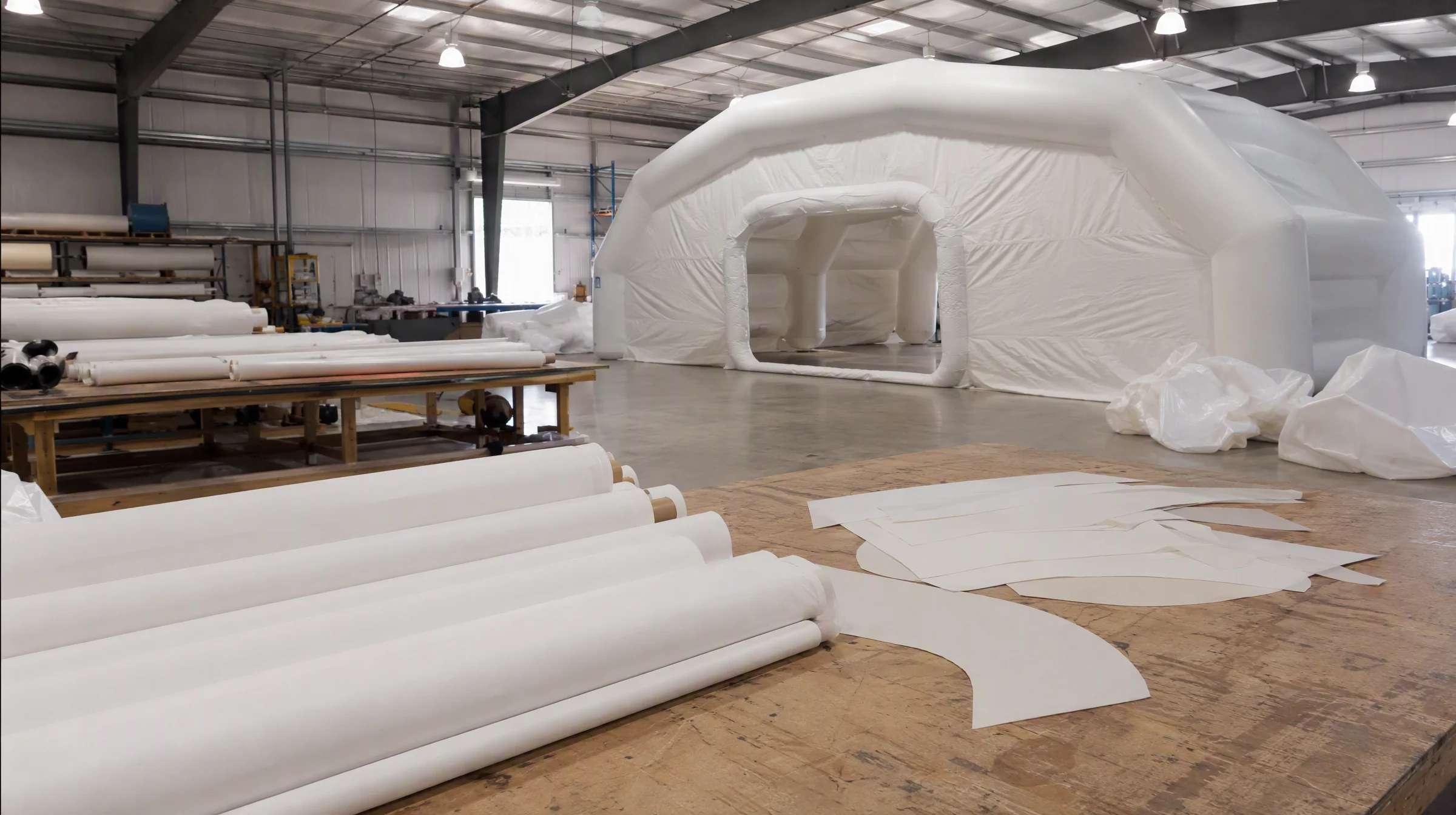
Inflatable fabrication studio with materials, templates, and a partially prepared inflatable structure.

FAQ

How the project process works.

Questions are grouped by the topics buyers ask about most often, so the page stays easy to scan on desktop and mobile.

Direct Answer

What this FAQ page covers.

These FAQs explain how the work is planned, reviewed, and delivered across the project stages that matter most. Answers remain visible in plain text, even while the page is still being filled out.

artwork

How should artwork be prepared?

What artwork file formats work for a printed inflatable?

Vector files with outlined type are the working standard, because printed panels are scaled to a size no raster file was made for. Supply a scalable master plus a flattened reference showing intended appearance. Raster elements can be used where unavoidable, but they must be supplied at the final printed dimension rather than scaled up from a screen-resolution original. Colour should be specified as a named system, not left to conversion.

Where should a logo sit on a curved inflatable surface?

On the flattest available area, oriented to the direction the audience will approach from. Placing a logo across a seam or across the steepest part of a curve breaks its proportions, and lettering suffers before symbols do. Decide the primary viewing angle first, then position the mark to be undistorted from that angle and acceptable from the others. Secondary faces usually carry a simplified version rather than the full lockup.

Why does flat artwork distort on an inflated form?

An inflated surface is a pressurised curve, not a flat plane. Printed panels are cut flat, then take their shape once the form is under pressure, so any graphic crossing that curvature stretches — most visibly near seams and at the point of greatest curvature. Distortion is predictable, so panel layout and compensation are applied before printing. Artwork supplied without a stated orientation and viewing distance cannot be compensated accurately.

How does the artwork stay readable at event scale?

Through a proof that shows the graphic mapped onto the actual form, not on a flat elevation. That proof reveals what a flat layout cannot: how the mark behaves across curvature, where seams fall, and whether the artwork still reads at the intended viewing distance. Colour is confirmed against the chosen fabric, since the same specification prints differently on different bases. Approval should be given on the mapped proof, not the flat file.

sizing

How does size get judged?

How do I know what size fits my venue?

Four measurements govern it: usable footprint, vertical clearance, the access route the deflated unit must pass through, and the distance the audience will view it from. Scale is normally set by the furthest intended viewing distance, then checked back against clearance and access. Working the other way — choosing a size first and fitting it afterwards — is where most projects fail, usually at the access route rather than the floor area.

How do I estimate size from a rough footprint?

Indoor or outdoor, an approximate footprint, the vertical clearance, and the distance the audience will first see the work from. A rough indication of role helps more than precise dimensions — whether it should read as an intimate feature, a room-scale environment, or a landmark across the site. Exact numbers are not needed to start; the intended relationship between audience and object is.

When should an installation read as a landmark rather than a feature?

When the audience needs to locate it before they reach it. A landmark is sized by its furthest sightline and works through silhouette, so fine detail is lost and should not be relied on. A feature is sized by close-range viewing, carries detail, and depends on people already being in the space. Sites with long approach paths or dispersed crowds usually need the first; enclosed spaces with controlled circulation usually need the second.

Which site measurements determine the maximum workable size?

Vertical clearance to the lowest overhead obstruction, not to the ceiling. Usable footprint after circulation, exits and fire lanes are excluded. The narrowest point of the delivery route, including doorways, lifts and corners. And the clearance required around the form itself, which is separate from its footprint. The access route is the most commonly missed of the four, and it is the only one that cannot be resolved on site.

cost

What changes project cost?

Why is cost not proportional to size?

Size changes cost, but it is never the only driver. The form itself, the amount of print coverage, seam complexity, reinforcement, access needs, installation method, and how many review rounds are required all influence the final number. A simpler larger piece can cost less than a smaller piece with more finishing, more structure, or more coordination.

What sits outside a production quote?

A production quote usually covers the making of the inflatable and the core fabrication work, but not every project cost sits inside that line. Freight, venue fees, customs handling, on-site crew, travel, storage, and some artwork or coordination work may be treated separately depending on the brief and the delivery scope. The quote should make those boundaries explicit.

What usually changes the project cost?

The biggest cost shifts usually come from complexity, not from one single variable. Artwork changes, unusual geometry, print coverage, special finishes, internal structure, access limitations, installation conditions, and the amount of planning required all move the price. When the brief is still open, the quote can only reflect the current level of certainty, not the final project state.

What should I prepare to get a useful quote?

A useful quote starts with a clear project type, approximate scale, venue context, timing, destination, and any reference material that shows the intended direction. If the campaign already has fixed constraints, those should be stated early as well. The more clearly the project role is described, the less the quote has to rely on assumptions.

freight

How is delivery planned?

How does destination affect freight mode and timeline?

Destination determines the available route, the gateway port or airport, the customs process and the practical choice between express, air and sea. The same installation can face materially different transit times depending on where it lands and how far inland the final delivery sits. An accurate recommendation needs the destination city or postcode alongside the packed volume, weight and required in-hand date — the country alone is not enough to plan against.

What do you need before arranging freight?

Destination country and city or postcode, confirmed quantity, final packed dimensions and weight, and the date the installation must physically be in hand. If there is a preferred incoterm, import port or nominated forwarder, that should be stated at the same time. Packing data must come from the confirmed production configuration — an early design estimate will not survive contact with a freight quotation.

How do you plan delivery around a venue date?

Start from the date the installation must be in hand, not the event opening date. Work backwards through final-mile delivery and customs, international freight, packing and inspection, production, and artwork approval. A setup and contingency buffer stays between arrival and the event. The schedule in a specific project quotation always takes priority over generic timing published on a website.

materials

Which materials suit the project?

What are the main fabric families and how do they differ?

The main fabric families differ in how they balance finish, flexibility, weight, repairability, and outdoor tolerance. Some materials are better for a clean premium surface, others are better for repeated handling or demanding site conditions. The right choice depends on the project role, how often it will be redeployed, and how much wear the finish needs to absorb.

How do you choose materials for indoor and outdoor use?

Indoor and outdoor projects face different pressures. Outdoor work has to handle weather exposure, anchoring, transport, and more physical wear, while indoor work often prioritises finish, visual control, and venue protection. Material choice follows the conditions first, then the visual goal. The same design may need a different fabric family once the site context changes.

Which fabric suits a campaign that redeploys multiple times?

A redeployable campaign needs a fabric that keeps its appearance after folding, loading, unpacking, and repeat installation. The best choice is usually the one that balances durability with a clean finish and predictable handling. If the same piece must travel often, the decision should favour stability, repairability, and a surface that still looks premium after repeated use.

inflation

How does inflation setup work?

What is the difference between a sealed-air and a continuous-blower installation?

A sealed-air installation is inflated, closed, and designed to hold shape without constant airflow. A continuous-blower installation stays inflated by remaining connected to a blower during use. The choice affects setup, sound, power, transport, maintenance, and how the piece behaves on site. The right format depends on venue conditions and the role the installation needs to play.

How does inflation setup work on site?

On-site setup starts with positioning, access, and a check that the site can support the intended format. The unit is then unpacked, connected or sealed according to its inflation method, and brought up gradually so seams, orientation, and stability can be checked in real conditions. Final adjustment happens only after the form is standing in its actual environment.

What happens during the first on-site inflation check?

The first check confirms that the form rises evenly, holds its intended shape, and matches the mapped proof in the actual venue. It is the moment to confirm orientation, surface tension, clearance, access, and any site-specific issues that only appear once the piece is standing. If something needs adjustment, this is the stage where it is easiest to correct.

lighting

How does lighting affect visibility?

How does internal lighting change what the audience sees?

Internal lighting changes the work from a surface object into a spatial signal. It can reveal volume, strengthen silhouette, soften edges, or make translucent material read more clearly from a distance. The effect depends on the fabric, the ambient light, and the colour relationships in the artwork. Lighting is part of the visual system, not an afterthought.

What should I consider if the project needs to work at night?

Night use changes how the installation is read. The surrounding light level, the contrast with the background, the power plan, cable routes, and the balance between illuminated and unlit areas all affect visibility. A piece that reads clearly in daylight may need stronger internal lighting or a different surface treatment after dark to keep the campaign legible.

leadtime

How should timing be planned?

How far ahead should I start the project?

For projects expected to ship by air or express, starting at least five to six weeks before the required in-hand date is a practical planning target. For sea freight to the current priority markets, roughly ten to fourteen weeks is more appropriate depending on the route. Complex structures, multiple approval rounds or larger quantities need more. These are planning targets, not quoted delivery times; the schedule in a project quotation takes priority.

How does changing artwork affect the project timeline?

Shape complexity, dimensions, quantity, sealed-air versus continuous-air construction, material and printing requirements, artwork revision rounds, structural and anchoring details, accessories, and the chosen freight method. The production clock should only be treated as running once artwork, dimensions and technical specification are all approved — not from the date of enquiry.

anchoring

How is the installation secured outdoors?

How do you secure an inflatable outdoors?

Outdoor installations may use reinforced D-rings or engineered anchor points with guy lines, ground stakes where the surface permits penetration, or ballast where it does not. The arrangement depends on the form's geometry, its size, the installation surface and the site's own restrictions. One fixed anchoring layout should not be applied across different structures.

What do you need from the site before planning anchoring?

The installation surface, available footprint, product dimensions and height, permitted anchor or ballast positions, any existing rigging points, pedestrian routes, venue restrictions, and whether the installation is indoor or outdoor. For outdoor use, expected weather exposure and any venue or insurer requirement should be supplied before the final anchor layout is approved.

At what wind speed should an outdoor installation be deflated?

There is no single wind-speed figure that applies to every installation. The deflation threshold depends on the specific structure, its dimensions, the anchoring plan, the site, and any lower limit imposed by the venue, event operator or insurer. Where a project-specific verified limit has not been established, no numerical value is published here. The installation should be taken down whenever conditions exceed the approved project limits or stability cannot be maintained.

process

How does the review process work?

When will I hear back after sending a project brief?

We reply within 1 hour, 7 days a week, 06:00–24:00 China Standard Time (UTC+8). Messages received outside these hours are answered from 06:00 UTC+8.

What happens after I send the project brief?

After the brief arrives, the review usually checks whether the direction is clear enough to move forward and whether any critical information is still missing. The team then aligns the project role, site context, and execution path before deciding what needs to be resolved next. The goal is to move from a broad idea to a workable plan without overcommitting too early.

How does the review work before production starts?

Before production starts, the review turns the brief into a mapped plan. That means checking the form, the artwork, the site context, the installation conditions, and the practical constraints that affect execution. The review stage exists to catch mismatches early, so the project can move into production with fewer assumptions and fewer late changes.

When is a custom inflatable the wrong format for a campaign?

A custom inflatable is the wrong format for a campaign when it needs a different kind of control, speed, or permanence than the site can support. If the venue is too constrained, the timing is too tight, or the visual role can be achieved more clearly by another format, it is better to say so early. The right answer is the one that fits the campaign, not the one that forces the campaign to fit.