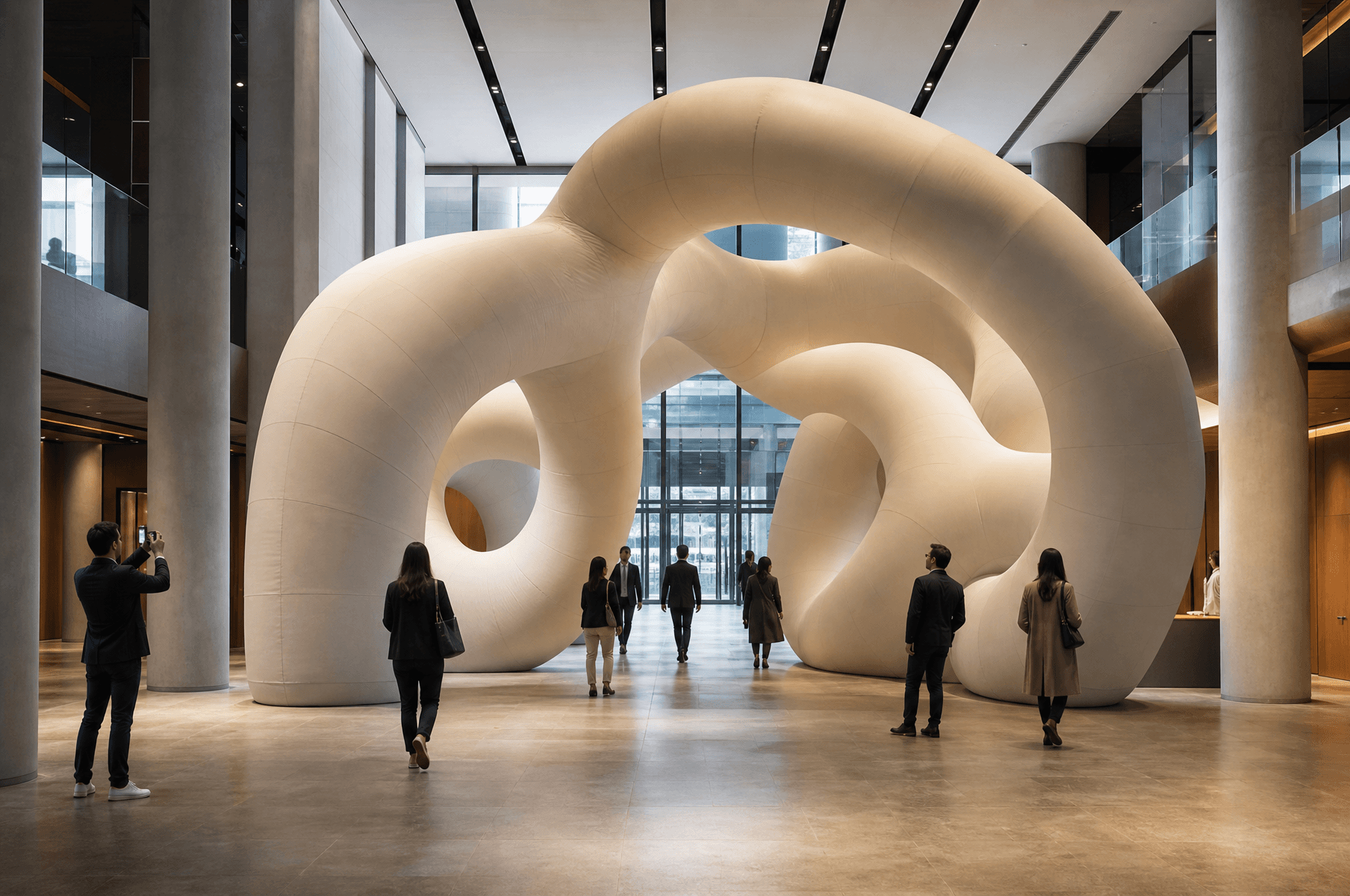
Visibility Starts With Placement
Where an environment sits often matters more than how large it becomes. The first encounter may happen at an approach path, venue entrance, atrium, stage-adjacent zone, open sightline, or campaign focal area.
Placement sets the moment when the audience begins to recognise the campaign. It also defines whether the work behaves as a landmark, a threshold, a destination, or a background presence inside the wider event.
A strong position gives the idea room to be read before the audience reaches it.
Scale Has to Work With Distance
Large-format work is experienced from different distances. At close range, people notice texture, entry points, shadows, and human scale. At mid-distance, the overall form and colour relationships become more important. From farther away, the environment may need to read as a clear landmark.
Bigger is not automatically more visible. The scale needs to make sense within the venue, the viewing distance, the ceiling height, the surrounding architecture, and the role the installation is expected to play.
The right scale lets the campaign hold presence without overwhelming the space around it.
Keep Campaign Cues Legible
When campaign language moves from a flat visual system into a physical environment, the most important cues need to survive the translation. Silhouette, colour relationships, proportion, rhythm, artwork hierarchy, and character all affect whether the audience can recognise the idea quickly.
The goal is not to place every visual element into the space. It is to protect the signals that make the campaign distinct when people see it from different angles and distances.
Legibility gives the environment a stronger relationship to the campaign, especially when the audience only has a few seconds to understand what they are seeing.
Architecture Changes What People See
The same installation can feel entirely different inside a glass atrium, retail hall, open plaza, stadium concourse, or festival site. Ceiling height, columns, glazing, lighting, background contrast, neighboring displays, and spatial clutter all change the way the campaign is perceived.
This is why early venue review matters. A form that looks powerful in isolation may need a different orientation, contrast strategy, or viewing path once it enters the actual environment.
For more detailed planning around venue conditions, see the live-event planning guide linked in the related paths below.
Audience Movement Creates Multiple Views
Real audiences do not experience a brand environment from one perfect front view. They arrive from side angles, pass at different speeds, gather in groups, pause for photography, and move around the work while the event continues around them.
A coherent environment needs to hold together from several viewpoints. Arrival angle, walking paths, passing traffic, interaction distance, crowd density, and different photo angles all influence how the campaign is read.
Thinking in movement helps the project become part of the audience journey rather than a single static backdrop.
Build a Moment Worth Photographing
A visible environment should also make sense through a camera. Clear silhouette, readable background, human scale, spatial depth, and a natural stopping point all help the campaign remain recognisable in photography.
This is not about promising a media outcome. It is about designing for photographic legibility: the ability for the installation, the audience, and the campaign language to remain clear in a single frame.
When the visual moment is well composed, people can understand the environment even outside the full venue context.
Visibility Is Part of the Experience
Campaign visibility is not only about being seen. It is also about how the audience enters, approaches, photographs, passes through, or remembers the spatial moment.
A brand environment can frame arrival, create a landmark, guide movement, support a launch reveal, or give a campaign a physical centre of gravity. Those roles are experiential as much as visual.
The most useful question is not simply whether the installation is large enough. It is whether the campaign remains clear as people encounter it in motion.
Questions to Ask Before Developing the Environment
Before moving into development, agency and brand teams can use the questions below to clarify how the campaign should appear in real space.
- Where should the audience first encounter the campaign?
- What distance should the environment read from?
- Which campaign cues must remain recognisable at physical scale?
- How will people approach, pass, gather, or photograph the work?
- What architectural conditions may compete with the installation?
- Which view should become the strongest campaign moment?