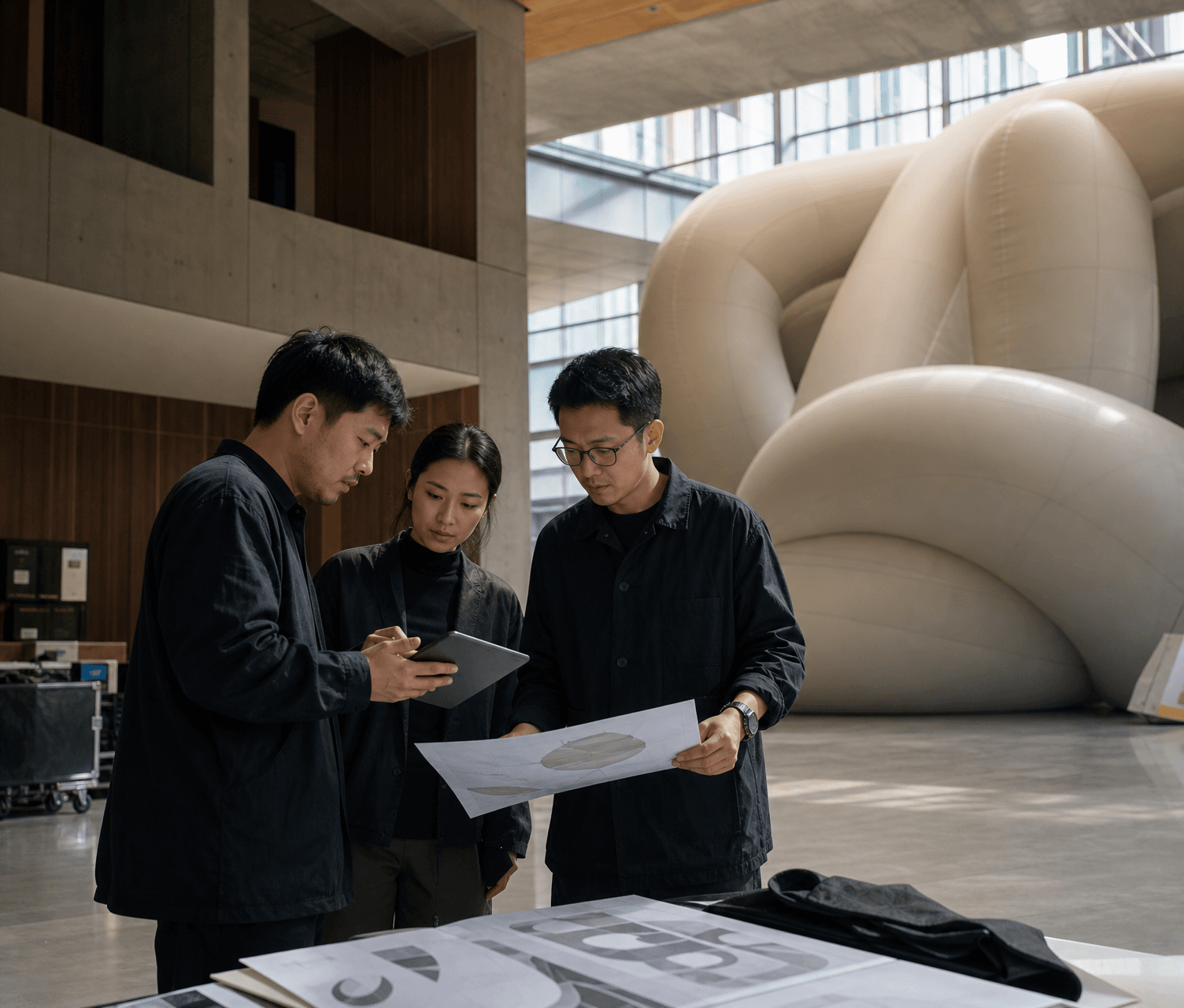
Start With the Experience, Not the Object
Before the form is defined, the project needs a role. What should the audience notice first? Where will they meet the installation? Should they move toward it, around it, through it, or pause inside its frame?
A live event installation may act as a landmark, an entry moment, a backdrop, a photo environment, or a spatial intervention. Each role changes the way scale, orientation, artwork, and guest flow should be considered.
The strongest briefs define the experience first. The object follows that intent.
Read the Venue Before You Define the Scale
The same creative idea behaves differently in a convention hall, retail atrium, outdoor plaza, stadium fan zone, or festival site. A form that feels cinematic in one venue may feel compressed, distant, or visually quiet in another.
Ceiling height, available footprint, sightlines, viewing distance, surrounding structures, entrances, exits, and neighboring installations all shape how the work will be perceived.
There is no useful fixed formula at this stage. The right scale comes from reading the space and understanding the campaign moment.
Think About Audience Movement
Large-format work is rarely viewed from a single front-facing angle. People approach from different directions, stop for photography, gather in loose groups, queue near interaction points, and move around the site under real event pressure.
The planning conversation should account for approach direction, crowd flow, photography angles, interaction areas, circulation clearance, queue formation, and venue access.
When movement is considered early, the installation can become part of the spatial environment rather than a static object placed inside it.
Separate Creative Ambition From Site Constraints
Creative ambition should stay visible throughout the project. Site reality should be brought into the conversation early enough to protect it.
Loading access, door dimensions, elevators, floor conditions, available power, rigging limits, outdoor exposure, anchoring possibilities, and installation windows can all influence the final approach.
The goal is not to flatten the idea into a checklist. It is to understand which conditions need to be solved so the visual direction can arrive with confidence.
Prepare Better Reference Material
A useful project review does not need a finished design. It does need enough context to understand the creative direction and the site.
Helpful inputs include the project idea or project type, approximate project size, indoor or outdoor context, event date, destination, venue photos, reference imagery, campaign artwork, sketches, and project notes.
This material helps the review stay focused on the project path: what the installation should express, where it will live, and what needs to be resolved next.
Plan Installation and Removal Early
Deployment thinking should influence the design early. Delivery access, setup window, positioning, power, anchoring, venue coordination, dismantling, and repacking can all affect how the installation should be shaped and prepared.
For live events, the quietest installation process is usually the result of earlier decisions. When the arrival sequence is understood, the design can support the crew, the venue, and the agency team instead of surprising them on site.
Give the Project Enough Room to Develop
Stronger projects benefit from early alignment between creative intent, site information, artwork, installation conditions, and execution requirements.
That alignment gives agency and brand-side teams space to review the idea, refine the visual direction, understand the venue, and prepare the handoff without forcing every decision into the final stretch.
The more ambitious the installation, the more valuable this early clarity becomes.
What to Send for a Project Review
For an initial project review, keep the material concise and useful. Send the project type or idea, approximate project size, indoor or outdoor context, event date, destination, project notes, and any reference image or artwork available.
The review can then focus on the relationship between creative intent, venue conditions, audience movement, and installation readiness.
- Project type or idea
- Approximate project size
- Indoor or outdoor context
- Event date
- Destination
- Project notes
- Reference image or artwork